
Most Know It’s Required. Few Have a Plan.
Most organizations have the mandate and the budget. What’s missing is a plan that all three stakeholder teams can actually execute.
WHY SEGMENTATION INITIATIVES FAIL
Six Reasons Segmentation Projects Fail to Become Programs.

No Shared Language
Networking, Security, and Compliance each define segmentation differently. Without a common framework, requirements never converge into a deployable plan.
No Asset Inventory
Most organizations begin a segmentation initiative without a reliable inventory of what’s on their network. You cannot classify what you cannot see.
No Enforcement Architecture
Existing infrastructure varies in enforcement capability. Without a phased strategy that accounts for hardware reality, segmentation stays theoretical.
VLAN Sprawl, No Security
Legacy network designs used VLAN sprawl as a substitute for real segmentation. The result is operational complexity without meaningful access control.
No Plan for East-West Traffic
Most organizations focus on perimeter security. Once a threat is inside, lateral movement between devices — sometimes within the same VLAN — goes unchecked.
Deployed and Forgotten
Segmentation that ends at deployment decays. Policy drift, unmanaged exceptions, and infrastructure changes erode the posture until the investment is lost.
BRAVO’S APPROACH
Built on Three Principles. Applied Before Any Product.
CLASSIFICATION
Bravo defines a hierarchical classification model that scales from macro to granular — applied from day one, before any enforcement policy is written.
PROPAGATION
A device classified in one location must carry that identity everywhere. Propagation failures are why segmentation works in a lab and breaks in production.
ENFORCEMENT
Policy is agreed in plain language before configuration begins. Enforcement is phased against infrastructure readiness, not a vendor timeline.
THE FIVE DIRECTIONS
Architecture Starts With One Question.
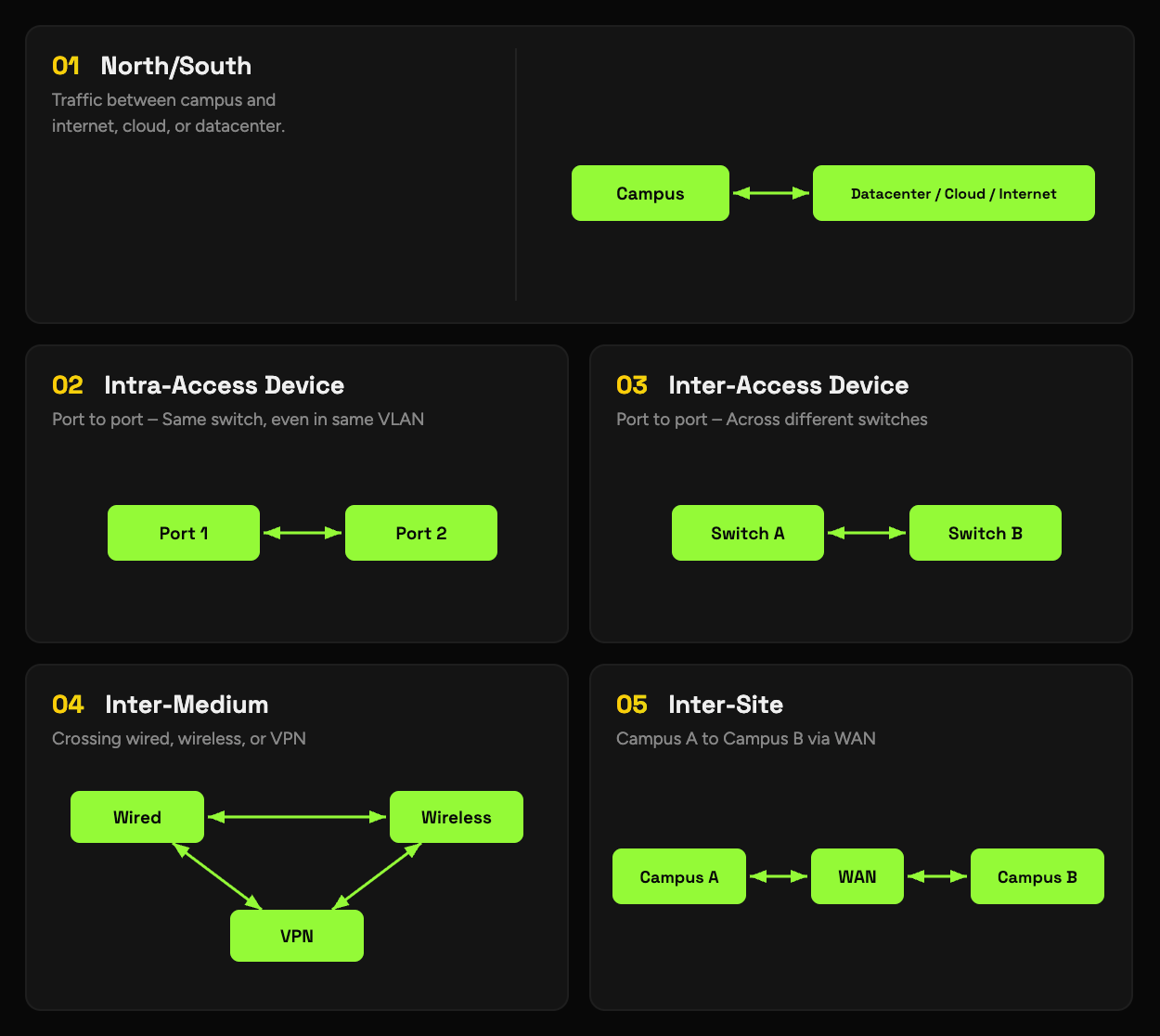
Before any architecture decision is made, Bravo has an explicit conversation with every client about which of the five directions of traffic represent the highest enforcement priority for their organization. North-South, Intra-Access Device, Inter-Access Device, Inter-Medium, Inter-Site — each direction carries different risk, requires different infrastructure, and demands a different enforcement approach. The answer determines the architecture, the phasing, and the infrastructure investment required. This is the conversation most segmentation engagements never have.
HOW WE DO IT
How Bravo Turns a Segmentation Initiative Into a Program.
Discovery & Project Matrix
Classification & Visibility
Enforcement Architecture
Phased Deployment
From Deployment to Program

Discovery & Project Matrix
Bravo begins every segmentation engagement with a structured discovery that produces a single output: the Project Matrix. It captures the endpoint landscape, business requirements, and policy intent in plain language agreed by all three teams. The Project Matrix is not a deliverable that gets filed away — it is the active reference for every configuration decision that follows.

Discovery & Project Matrix
Bravo begins every segmentation engagement with a structured discovery that produces a single output: the Project Matrix. It captures the endpoint landscape, business requirements, and policy intent in plain language agreed by all three teams. The Project Matrix is not a deliverable that gets filed away — it is the active reference for every configuration decision that follows.
WHERE TO GO FROM HERE
The Right Technology Depends on Your Environment.
Security is a program
Security is a program, not a project
Policy drifts. Infrastructure changes. Exceptions accumulate. Bravo’s Co-Managed services keep your security program current — with the same engineers who built it supporting it over time.